Questions I can’t answer
Let’s have some good faith arguments

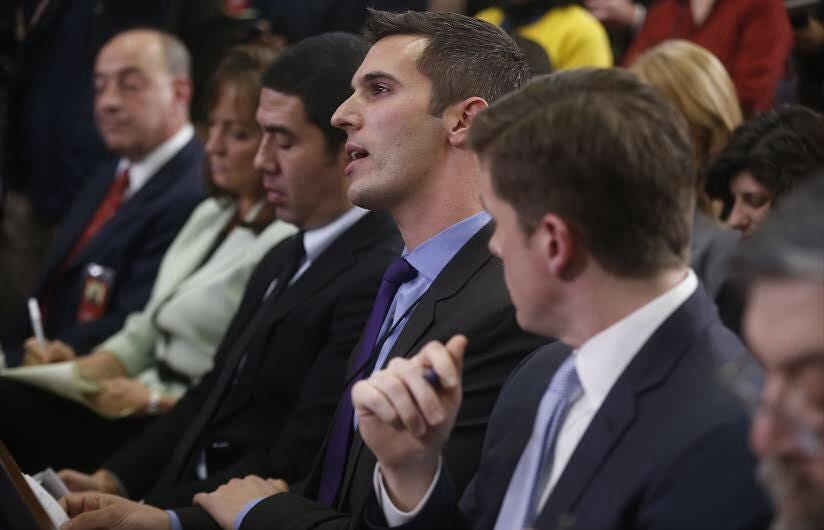
I was a White House correspondent when the Arab Spring began. A street vendor in Tunisia set himself on fire as an act of protest in 2010. Thousands of people began to march in the streets of Tunis. Soon, millions of demonstrators were protesting against autocracy and corruption across the Middle East and North Africa.
This hopeful moment was brutally extinguished. In Syria, what began as a wave of pro-democracy demonstrations devolved into a horrific civil war that lasted years. Bashar al Assad used chemical weapons against his own people, obliterating entire populations in an effort to cling to power. (He was finally ousted in 2024.) The groups fighting against his army ran the gamut from moderate Kurdish militias that supported the US to the death cult that called itself the Islamic State.
As this chaos unfolded, I sat in the White House briefing room nearly 6,000 miles from Damascus. Each day, the press secretary would take questions from those of us in the press corps. From my assigned seat in the middle of the second row, I asked variations of the same question as the war raged for months and then years: What does President Obama believe the US role in this conflict should be?
The White House’s answers were murky at best. Red lines were drawn, crossed, and then ignored. As I put it in a 2013 report, “That’s pretty typical of U.S. efforts to shape the Mideast nowadays: Whatever Washington says mustn’t happen, happens.”
In that context, friends often asked me a legitimate question: What did I think the US should do in Syria? My simple, honest answer was: “I have no idea.”
It wasn’t that I lacked information. Every day I was reading think tank analyses, newspaper op-eds, and accounts from war correspondents explaining the complicated details of the conflict. I was interviewing senior members of Congress, military officials, and national security advisors to the President. My lack of an opinion didn’t reflect a lack of knowledge. It reflected the fact that in Syria, there were no good answers. I was grateful that my job was to ask tough questions. Deciding what to do was someone else’s problem.
I think most journalists are used to being asked how we keep personal opinions out of our reporting. I’m not dismissing that concern. It’s real, and maybe someday I’ll write about it. But non-journalists might be surprised at how often I genuinely don’t have an opinion about something I have spent a lot of time researching.
Or maybe, “I genuinely don’t have an opinion” is too simplistic. It would be more accurate to say that my opinions are so mired in a deep thicket of cost-benefit trade-offs that I couldn’t choose a path out if I tried. Fortunately, I don’t have to try.
I have never longed to be a person shaping policy. I think one reason I’m good at asking tough questions in interviews is that I’m able to see the weak spots in most plans. In my 25 years at NPR, I often found that the more I learned about a problem, the less confident I felt about how to solve it.
To give just a few examples -
What should US-Mexico border policy be?
How much should the government regulate social media?
Does artificial intelligence pose more of a threat or an opportunity?
Should Ukraine keep getting American weapons indefinitely, or should US support be conditional?
I have done lots of reporting on all of these questions, and I sincerely don’t know the answer to any of them. I can make good faith arguments pointing in opposite directions. Some of this might tie back to my Jewish upbringing. In my experience, Judaism is a religion that values questions over answers and debates over dogma.
As a host of All Things Considered, I often pitched segments that dug into the complicated gray areas of public policy debates. When the country was beginning to reopen after the first pandemic lockdown in mid-2020, I talked to business owners whose storefronts straddled city and state borders with different policies. When Mpox (which we then called monkeypox) was spreading in 2022, I interviewed Yale Public Health expert Gregg Gonsalves about how to address the disease’s disproportionate impact on gay men without creating stigma or homophobia. “We have to figure out how to hold two thoughts in our head at once,” he told me. Nuance! What a concept.
In politics today, I often feel like we are drowning in bad faith arguments. Health care, climate change, and global trade are thorny, complicated problems. So why is it so difficult for political leaders to talk about them like grown-ups? I see too many elected officials push policies based on what will go viral, what fires up the base, or what wins that day’s news cycle. The most important question—what makes good public policy—is often so far down the list that it gets buried under everything else.
This isn’t just about finding the center point between two extremes. It’s about weighing difficult trade-offs in situations where there is no perfect solution. I think one reason the Ezra Klein and Derek Thompson book Abundance struck such a chord is that it wasn’t afraid of digging into those nuances, or of slaying sacred cows. I felt the same way about Michael Grunwald’s book, We Are Eating the Earth. It made me think differently about industrial agriculture (speaking of slaying cows), an issue where I had thought there was no gray area. To be clear, I haven’t become a cheerleader for factory farming. I still grow my own garden vegetables and shop at my neighborhood farmers’ market. But I’ve added industrial agriculture to the list above, of questions where I can’t tell you what the right policy should be.
I have been imagining a debate show. Maybe a weekly podcast. It could be called “A Good Faith Disagreement,” or “Convince Me.” At the start of each episode, I would explain why I find a given issue so vexing. Two guests who disagree would show up with research, and with nuance. I could call bullshit on any arguments that ring false. (So I guess this wouldn’t be on public radio.) Maybe by the end of an episode, one of the guests would even convince me.
I have shopped this idea around a bit, and it hasn’t gotten much traction. I understand why. A show like this doesn’t win the news cycle. It isn’t designed to go viral. It doesn’t fit our era of showbiz, moral outrage and Like!/Share!/Subscribe!
There are other show concepts that I’m pitching, ones that have a little more zing. My hope is that I’ll wind up assembling a portfolio of projects, short- and long-term, on a variety of platforms. But in life as in public policy, I am aware there is no one right path. Wherever I land will involve some cost-benefit trade-offs; giving up free time for a bigger paycheck, or sacrificing my autonomy for the prestige of a title. I’m enjoying this phase of exploration, meetings, and brainstorming sessions, all the more so because I know it won’t last forever. As Stephen Sondheim famously said, “The choice may have been mistaken; the choosing was not. You have to move on.”
It takes a while to reset your mind after you have worked in a culture for so long. I still react like a Timeswoman, even though I left the staff 15 years ago and have worked other places since. Your detox will go on. But I’d listen to Convince Me. It could be a Today, Explained cousin.
I really appreciate this post. I used to work in medicine, sometimes the answers to questions was not clear, more information needed. I don’t know, research needed, sometimes even that didn’t give a full answer.
Thank you - it’s an important perspective, the world’s issues aren’t clear. There are so many variables. What does help a bit, in terms of making a decision, is asking myself ‘who benefits, who is burdened, who is left out…”
I appreciate the book references as well.