What is a podcast?
Audie Cornish and I bring our “Engagement Party” to On Air Fest in Brooklyn

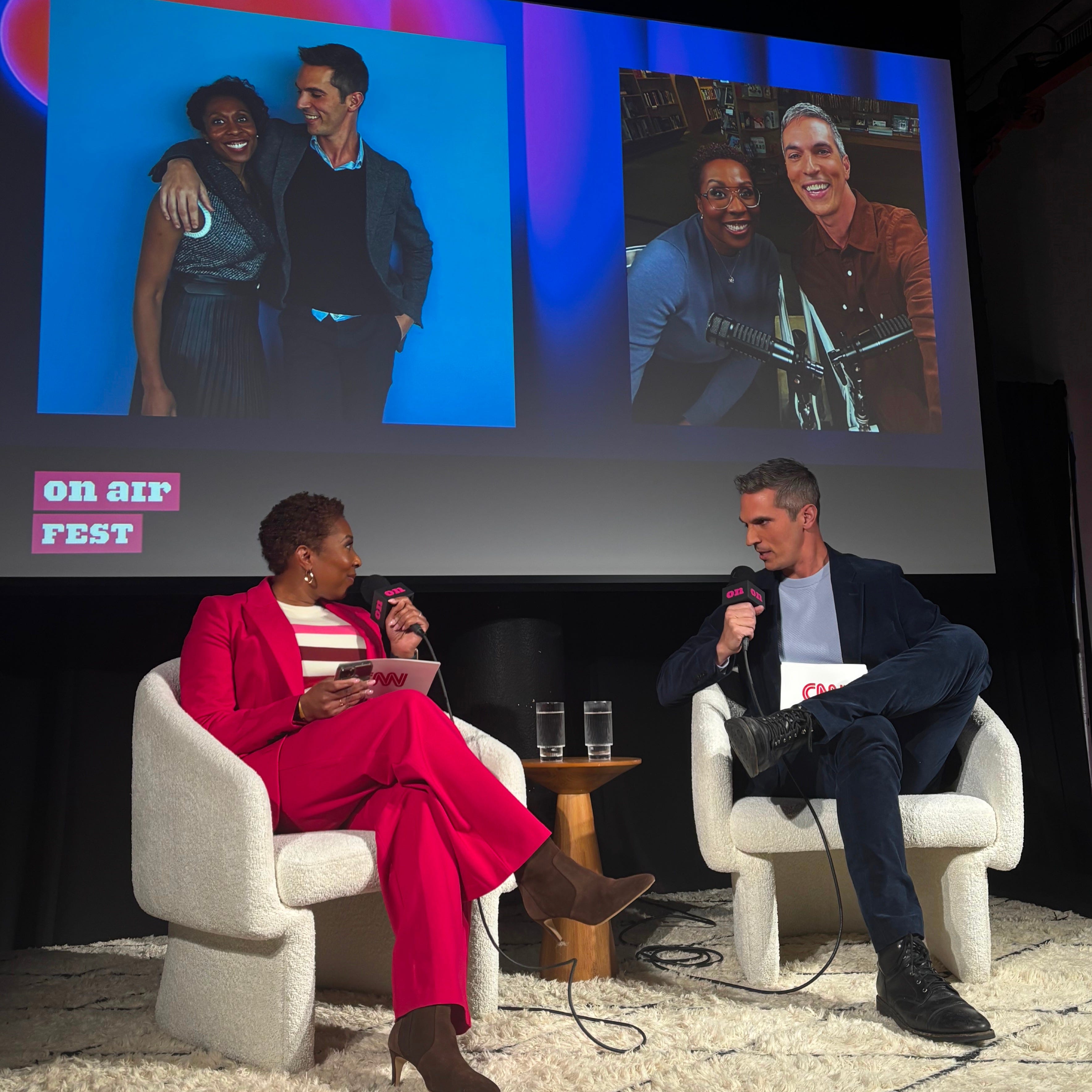
When I tell people about the project that Audie Cornish and I have been developing with CNN, the conversation often starts to sound like a bad Abbott and Costello routine:
“We’re piloting a podcast.”
“So it’s just audio?”
“No it’s also video.”
“So it would be a CNN show?”
“Yeah but on YouTube.”
“So what makes it a podcast?“
Fair question! Right now the entire industry seems to be asking some version of, “What makes it a podcast?” (If you want to skip that discussion and just watch what we’ve made, scroll down or click here.)
As the New York Times put it back in July, “An audio-only medium spawned a giant industry that is now largely focused on video.” Reporter Joseph Bernstein wrote:
According to an April survey by Cumulus Media and the media research firm Signal Hill Insights, nearly three-quarters of podcast consumers play podcast videos, even if they minimize them, compared with about a quarter who listen only to the audio. Paul Riismandel, the president of Signal Hill, said that this split holds across age groups — it’s not simply driven by Gen Z and that younger generation’s supposed great appetite for video.
In last month’s Vanity Fair story about “The New Late Night,” I was surprised to see Bowen Yang and Matt Rogers of Las Culturistas among the “hosts who are shattering the talk show format.” I love them, but I think of them as podcasters, not late night hosts. Then again, I see clips on social media of them interviewing movie stars and pop icons back to back with clips of Seth Meyers and Stephen Colbert interviewing the same celebs. So maybe there actually is no meaningful difference? As the VF article by Joy Press says:
Streamers are neck and neck with broadcast and cable TV networks these days, and YouTube ranks as America’s most watched streaming service, consistently beating out Netflix. In October viewers watched more than 700 million hours of YouTube podcasts on their living room devices, up from 400 million the year before. Netflix is fighting back, recently signing deals with iHeartMedia, Barstool Sports, and Spotify to create its own heavy-hitting video podcast slate.
The podcast pivot to video isn’t a complete takeover. The audio-only, sound-rich Fela Kuti: Fear No Man by Jad Abumrad was widely ranked the best podcast of 2025, and there is no way to “watch” that show. But I think Fela is the exception that proves the rule. After all, the video interview show Good Hang with Amy Poehler won the first ever Golden Globe for podcasting. And anecdotally, as someone who has met with lots of podcasting executives over the last few months, I can say that right now video seems to be a baseline requirement for any new project to get greenlit.
Building a show for audio and video at the same time has a cost. While I love interview and chat podcasts like Las Culturistas and Good Hang, there is a limit to what they can do. The storytelling techniques that make the best audio narratives come to life simply aren’t available when a show has to work on both platforms at once. Creating a show that you can either watch or listen to can be a bit like taking a box of 64 crayons and deciding to use only shades of blue. Limitations can unlock creativity, and you can create gorgeous art with blue - just as Picasso! But inevitably, you have to narrow your scope.
I suspect this is one reason This American Life, Radiolab, The Daily, and other marquee podcasts that have been around for years haven’t become video-audio crossover shows. They would have to completely reimagine how they approach storytelling. In the early aughts there was a TV version of This American Life on Showtime for two seasons, but those stories were built from the ground up using visual storytelling tools; they weren’t just audio narratives with a lurking camera.
This was all hanging in the air as Audie and I took the stage in Brooklyn last week at a major podcasting conference called On Air Fest. Nieman Lab’s big takeaway from the gathering? “‘Podcast’ meant nothing and everything at On Air Fest.” Reporter Neel Dhanesha put it this way:
Most of the programming consisted of live episode tapings rather than discussions of craft, and I heard the term “creator” just as often as “journalist” at On Air Fest; some of those “creators” were longtime journalists like Don Lemon, who’s now doing his own thing after leaving CNN in 2023; others explicitly said they were not journalists, even if they borrowed some tools of the journalism trade. The journalists, meanwhile, are also borrowing from the creator toolkit, particularly when trying to build an audience, but don’t want to let it affect their reporting approach.
With the two pilots of Engagement Party that we’ve produced so far, Audie and I are exploring what we could build that straddles both video and audio. The idea is to share the kinds of conversations we used to have in the NPR studio when our microphones were off, when we’d finish each other’s sentences and make each other laugh between serious segments about the news. (You can watch our previous episode here.) I think there’s something about the chemistry of a 20+ year friendship that you just can’t manufacture in a lab. And Audie hosts the 6 AM show on CNN every weekday, while I just finished a decade hosting All Things Considered, so right now neither of is craving a new venue to discuss the war with Iran. .
As you’ll hear—or see—in our live show from On Air Fest, we start off by trying to put some of the issues that I’ve described here into perspective. But this episode isn’t just about the state of the industry. We also get personal in our discussion of what it means to have a work spouse. And in our “touch grass” segment, we talk about what’s getting us away from our screens.
I’m having a blast reuniting with Audie to make these pilots, and I hope that joy is contagious. If you’d like to see this become a more regular thing, please share it with your friends. Cliche as it sounds, word of mouth is powerful and it makes a difference when you like/comment on/share an experiment like this.
You can watch—or listen—to the entire episode here:
Extra! Extra! Extra!
One of my favorite sessions at On Air Fest featured Radiolab host Lulu Miller and the guitarist Kaki King. They called it The Musical Apothecary.
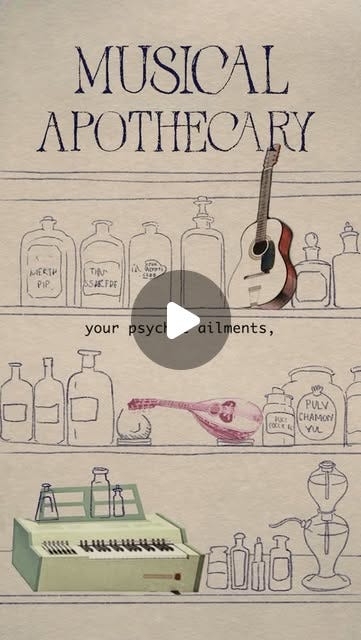
People from the audience came up to the microphone and described what was ailing them. The maladies included death of a friendship, extreme extroversion, and a German word that I was unfamiliar with: torschlusspanik, the fear that time is running out.
While Lulu talked a bit about the science behind what music does for the mind and the body, Kaki King composed a cure on her guitar. I hope that they decide to release the full session as a Radiolab episode. But in the meantime, you can find more about Kaki King and her music - perhaps even a cure for what ails you - on her website.
Love you two! Love Engagement Party! Thank you for sharing this on Substack! 💗💗💗