Will NPR be ok?
And why I believe the answer is yes…eventually.

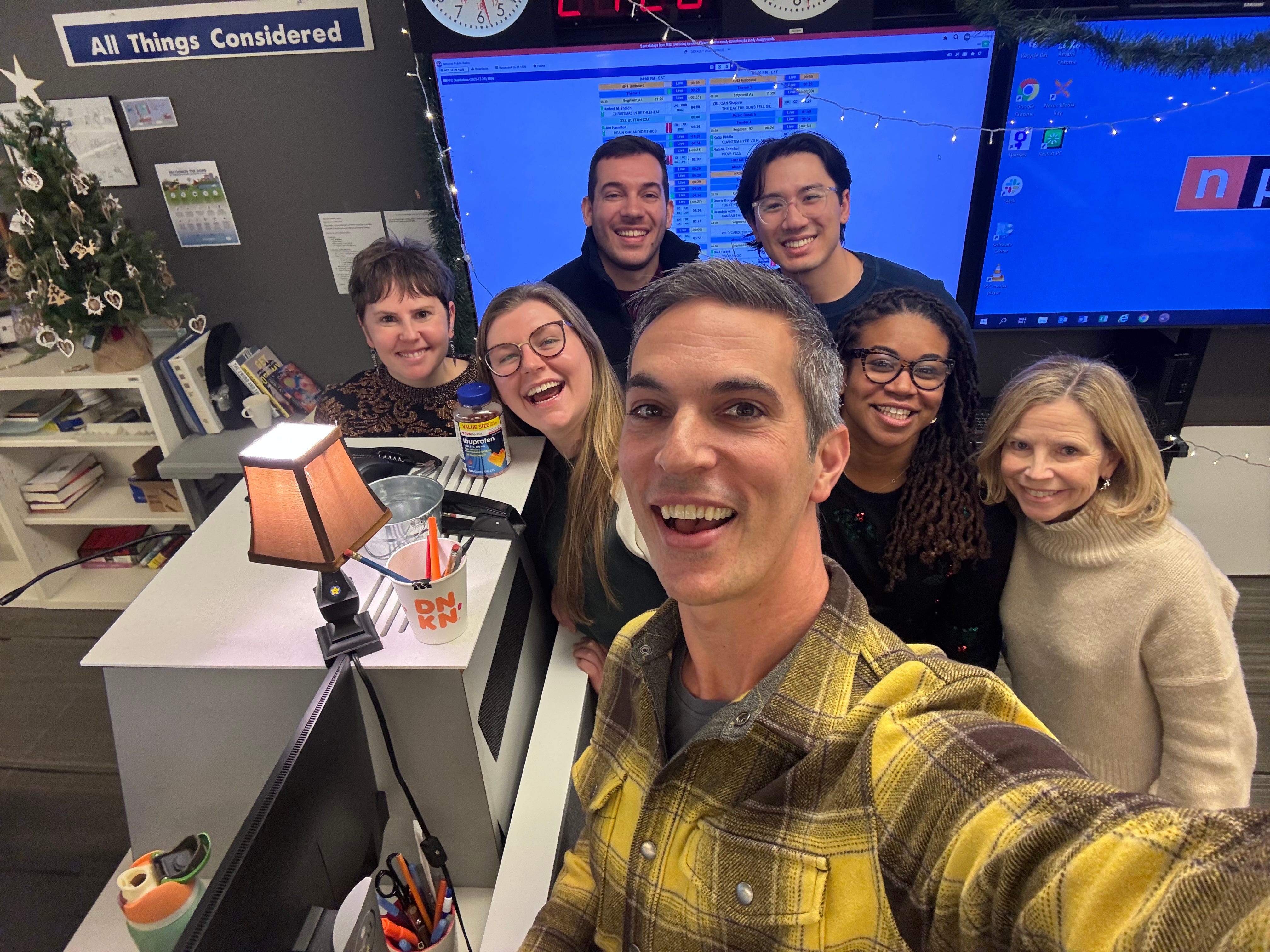
Family, friends, and people who stop me on the street as I’m walking my dogs (hello, neighbor) have asked me two questions constantly since I left NPR a few months ago.
What are you doing with your time? (Answer: Lots of things. I’m not keeping any secrets, it’s all here in the newsletter and on my Instagram.)
Will NPR be ok?
Today, I’m going to try to tackle the second question.
Sometimes you see things more clearly from the outside looking in. On Christmas Day, I stopped by NPR headquarters for the first time since I left the company. I have worked every Christmas for more than a decade, since I got my start as a guest host on Talk of the Nation December 25, 2008. Last week I brought cookies to the staff, which was entirely unnecessary since the pile of homemade Christmas cookies was already towering before I arrived.
As I caught up with old friends and colleagues, I mentioned something that has become clearer to me since I’ve left, which might be harder for people to see inside the newsroom: While NPR may be staring down a tough couple of years ahead, I think public radio is better positioned in the long run than most American news organizations right now.
First, the bad news: Since the Trump administration ended federal funding for public media back in July, public radio stations across the country have struggled to keep their doors open. Rural areas have been hit hardest. NPR CEO Katherine Maher estimated that 80 stations may close in the next year. And the loss of money has hit big cities, too. In San Francisco, KQED cut 15% of its staff. KCRW in Los Angeles cut staff by 10%.
Some stations did break fundraising records in the days and weeks after the government clawed back money from the Corporation for Public Broadcasting. But everybody recognizes that one successful fund drive can’t easily replace a steady cash flow from the federal government year after year.
In the public radio system, government money generally trickled up the food chain. Funds from the Corporation for Public Broadcasting mostly went to local stations, then those stations paid programming fees to NPR for shows like Morning Edition and All Things Considered. Programming fees from stations make up about a third of NPR’s revenue.
Right now, there is massive uncertainty around the financial outlook for public radio. Stations don’t know whether donors will continue to fill the gaping budget hole that the CPB left. Foundations might help, but nobody knows how much. Therefore, NPR can’t predict how much money it will get from stations.
Leaders don’t want to cut more than they have to. They also don’t want to take a piecemeal approach to any cuts that might eventually be necessary. So in the newsroom, everybody is waiting for the other shoe to drop (while continuing to produce hours of daily programming, meet constant deadlines, and cover history-making events around the world).
For the time being, the only big change that NPR has announced as a result of the funding cut is a $5 million trim to the network’s $300 million annual budget. That will allow the company to reduce programming fees and give some breathing room to stations that are trying to figure out the path forward. NPR has not announced any layoffs, buyouts, staff reductions, or major cutbacks. Yet.
Everyone I know in the public radio system emphasizes the “yet.” Although I’m not aware of specific plans, I expect that 2026 will be a year of dramatic change at NPR. Those changes may bring some efficiency and could fix structural problems that have been baked into the public radio system for a long time. But they will also undoubtedly hurt. I would not be surprised if people lose their jobs. And then, on the other side of those changes, I believe that public radio will be better positioned than almost any other news organization in the country.
(As I’ve said before, the political climate and the future of public radio had nothing to do with my decision to leave NPR. You can read more about my reasons for leaving in this post.)
Here’s why I believe NPR has a brighter future than other American news organizations. Right now, many of the biggest newsrooms in the US fall into one of two camps. Some are beholden to corporations that are trying to win favor with the Trump Administration. Look at the saga around the 60 Minutes story that CBS News editor in chief Bari Weiss shelved. Or read this piece in The Atlantic last week about the future of CNN. As Franklin Foer put it:
The fate of Warner Bros. Discovery is no longer a regulatory matter. It is a medieval tournament, in which the king invites rival bidders to compete for his approval. To acquire the media company, the aspirants—Paramount and Netflix—will have to offer a sacrifice: Whoever can damage CNN the most stands to walk away with the prize.
This is one of those moments in Donald Trump’s presidency when an event that would otherwise be recognized as a death knell for democracy somehow fails to elicit the outrage it deserves. Warner Bros. Discovery owns CNN, whose coverage Trump views as hostile to his administration. So he is abusing the government’s merger-approval power in order to insist that the next owner of the venerable outlet mold its journalism to his liking.
So in one corner, some august news organizations are owned by mega-corporations willing to sacrifice principles of journalism to advance larger business interests.
And in the other corner, some newsrooms are at the mercy of individual billionaire owners and their whims. Take Jeff Bezos, owner of The Washington Post. As Politico wrote back in April:
At the Post, he abruptly squelched a Kamala Harris endorsement and then decreed that the paper would henceforth only publish pro-market opinions — making himself look nakedly ideological for the first time. And his ideological inclination, on display when he joined the cast of tycoons taking prime spots at Donald Trump’s inauguration, began to look more self-serving than selfless. The man who once praised democracy’s guardrails has begun to look like he’s just another rich guy trying to curry favor with a transactional president.
A similar dynamic has played out on the West Coast, as the billionaire owner of The LA Times has tried to steer that paper in a more MAGA-friendly direction.
There are, of course, exceptions. The Emerson Collective, founded by Laurene Powell-Jobs, continues to fund outstanding independent journalism. Emerson uses both for-profit and nonprofit models, at outlets from The Atlantic to ProPublica. Smaller nonprofit news organizations are popping up all over the country. In Lancaster, Pennsylvania, my friend and former NPR colleague David Greene is helping to keep his hometown newspaper alive.
But these are outliers. News deserts are growing. In the last 20 years, nearly 3,000 newspapers have stopped publishing, according to a recent report from Northwestern University’s Medill School of Journalism. And so when I look for news organizations doing credible, responsible journalism on a local, national, and international level, I think public radio stands almost alone.
I do not mean to imply that NPR is a bastion of the resistance. The aim of public radio is not to counterbalance MAGA-leaning corporations. Rather, independent journalism itself is a defense against encroaching totalitarianism. Public radio is the increasingly rare independent US news organization that exists free of political pressure.
Public radio newsrooms are places where editorial decisions are made by journalists, not business owners. The organization is accountable to the public, not to funders. It is, as the writer and botanist Robin Wall Kimmerer told me, an economy built on principles of reciprocity and abundance. And that will be even more true after the public radio network emerges from the crisis it is in now.
I violated one of my own cardinal rules in the headline of this post. I often say that, “Will we be ok?” is not a useful question. The better question, I have argued, is, “How can I be useful?” In the case of public radio, at least, the answer is easy. If you believe in what public radio stands for, donate. The future of NPR is murky. But it is also entirely within our control.
Extra! Extra! Extra!
Today, three shows I’ve recently binged that I would recommend -
Heated Rivalry: I love the Cinderella story of how this small Canadian show became one of HBO’s biggest hits of the year. And I’ve also been surprised by how many of my (queer, male) friends have said watching this romance about two male hockey players made them feel a sense of grief. Esther Perel and others have written eloquently about the sense of loss we feel for lives we never had the opportunity to live. For many queer people—even those who see themselves as lucky, with lots of privileges and relative acceptance—Heated Rivalry seems to have tapped into a sense of what could have been if they’d grown up in a world that was less hostile to same-sex love.
Pluribus: I was a fan of Vince Gilligan’s Breaking Bad and never made it past season 1 of his spin-off, Better Call Saul. (Friends have told me I’m missing out. I might go back to it eventually.) Gilligan’s latest show is just as visually stunning, shot by shot. Like the others, it’s set in New Mexico. The sci-fi premise, which I won’t try to summarize here, reminds me a lot of Mrs. Davis, the under-appreciated masterpiece that I’ve written about before. I wish Gilligan had given his Pluribus star, Rhea Seahorn, a wider emotional spectrum to play with. She spends most of the season stuck in anger. Still, I’ll tune in to season 2 whenever it comes along. Gilligan says it could take a while.
Slow Horses: I’m glad I didn’t discover this show until five seasons were already available to stream. I’m embarrassed to admit how quickly I ate them up. Slow Horses is a spy thriller set in London about a bunch of MI5 agents who’ve flopped out. Their leader, Jackson Lamb, is the role of a lifetime for Gary Oldman. The show is based on a series of books by Mick Herron. And when I finished streaming Slow Horses, I was happy to discover that there’s a new series based on a different set of crime novels by Mick Herron. Down Cemetery Road is next in the queue.
Happy new year, and thanks for reading. See you in 2026!
The University of Missouri-Kansas City is evicting NPR affiliate KCUR and Classical KC by January 31. UMKC has not provided the stations any alternative sites. Appparently they're just kicking KCUR out. Shameful. If you could help spread the word, maybe UMKC can be pressured into helping KCUR and CKC.
Miss you Ari!!❤️